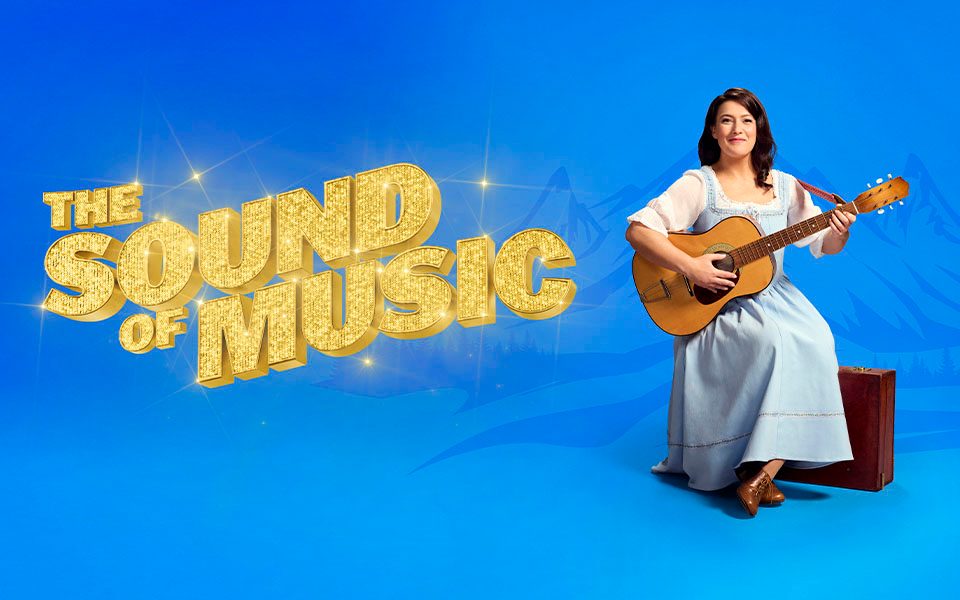
In 1965, when I was 15, I used to get the New Musical Express every Friday to check on my favourite acts. The LP chart was mainly occupied by the Beatles and the Rolling Stones until, one week, 17th April, The Sound of Music Soundtrack suddenly appeared, rubbing shoulders with the aforementioned groups, The Pretty Things and a couple by Bob Dylan. It stayed there for 238 weeks, still providing a stark contrast, but now to Osibisa, Emerson, Lake and Palmer, Free, Pink Floyd and Leonard Cohen. Not only that, but having opened at the Majestic Cinema in Leeds City Square at the same time, it ran for a record 2 years and 5 months to over half a million cinema-goers. The previous record holder was South Pacific with 38 weeks. A lady called Myra Franklin from South Wales was featured on the news after having seen the film more than 500 times, that is in the cinema, as there were no tv recorders or streaming services at the time. I finally relented and went to see it during the summer holiday in 1966 between leaving school and starting college. After only having heard the frothy songs on the radio, I was surprised at how dark the plot turned towards the end.
I pass on these pearls of wisdom on in order to illustrate to my younger readers, i.e. the under 50s, the huge impact the flick had on popular culture in the Swinging Sixties – and beyond. The original stage version, based on a book by Howard Lindsay and Russell Crouse, suggested by The Trapp Family Singers by Maria Augusta Trapp, opened on Broadway on 16th November, 1959. The production we saw this evening was first perfomed at Curve, Leicester on 25th November, 2025. I believe that these dates are important in appreciating the work.
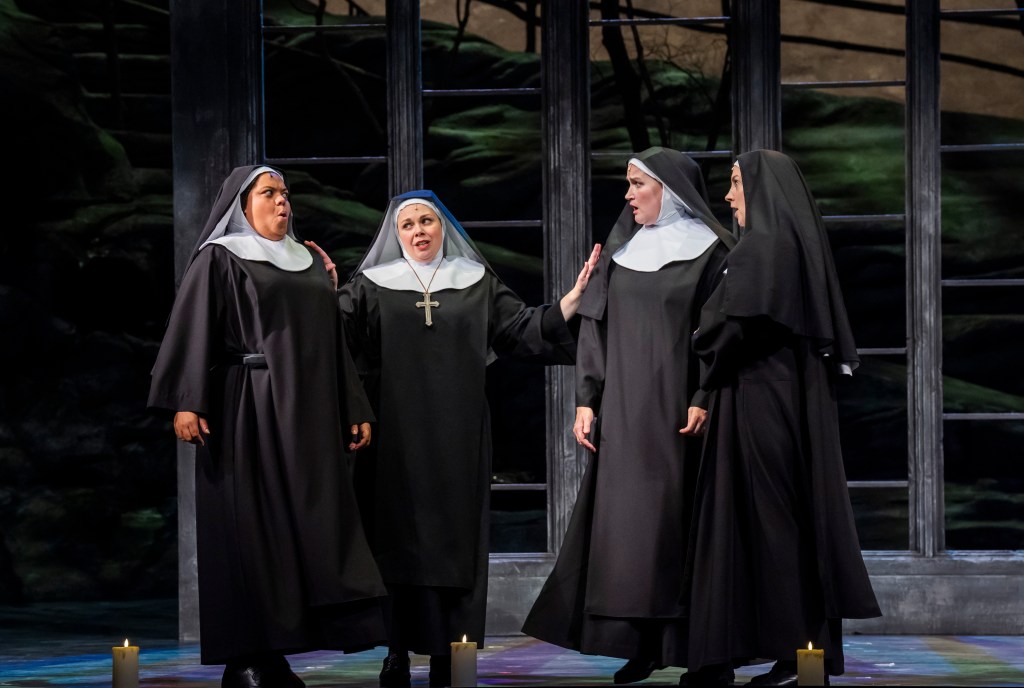
The story is set in Nonnberg Abbey, Salzburg, Austria, in 1938 where Maria, a free-spirited trainee nun, is told by the Mother Abbess that she is not really cut out for orders and has been found a position in the household of a retired naval officer, Captain Georg von Trapp, as governess to his seven children. The Captain is a widower who has not been gifted with parenting skills and runs his house like a military establishment, meaning that Maria’s predecessors have left after a short time. When he goes on a trip to Vienna, Maria decides to break with the regime and introduce music and laughter into the lives of the children, something which their mother used to do. She removes the curtains from her bedroom and makes play clothes with them, to replace the uniforms insisted upon by the Captain. Her charges warm to this and refrain from playing practical jokes on her, as they did with the other governesses.
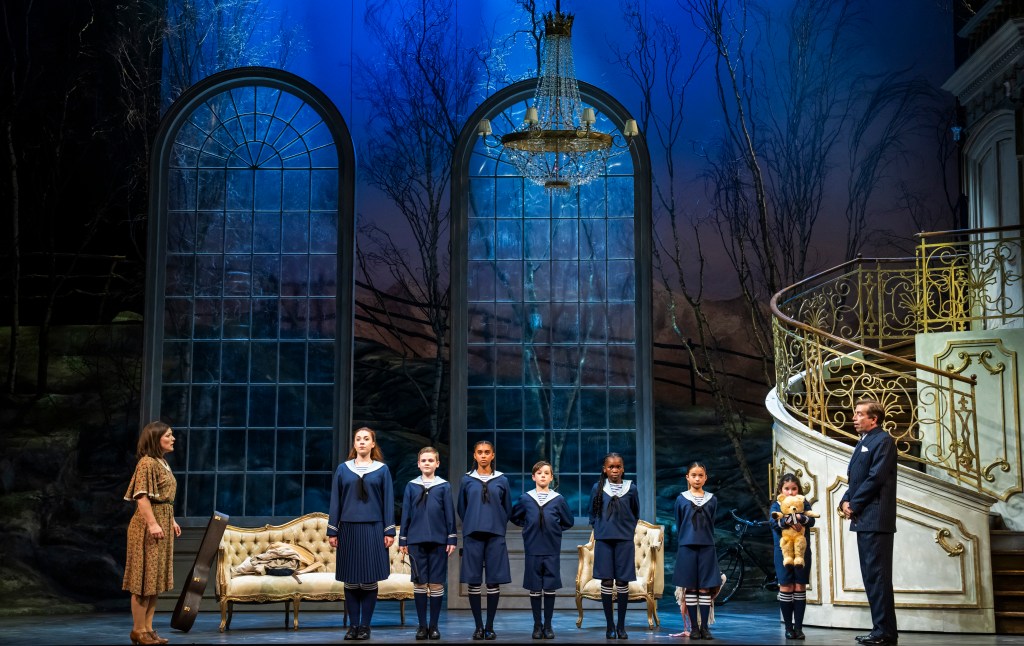
On his return, the Captain is not impressed with the transformation, but, as he has brought home a wealthy socialite, Baroness Elsa Schrader, whom he wishes to marry, and a mutual friend, Max Detweiler, he doesn’t immediately castigate Maria. His mood is mellowed somewhat when the children sing a song to welcome their titled guest, which she appreciates and takes them to her heart. Max is the organiser of the Salzburg Festival and persuades the Captain, not only to let the children perform in the event, but also to take part in the songs himself.
During a party thrown by the Captain to welcome his fiancée, he sees Maria teaching his son, Kurt, a traditional dance and he excuses himself to join in. The Baroness is jealous but, Maria has developed feelings for the Captain and, as she too is envious, returns to the convent without telling anyone, leaving nature to take its course with the happy couple.
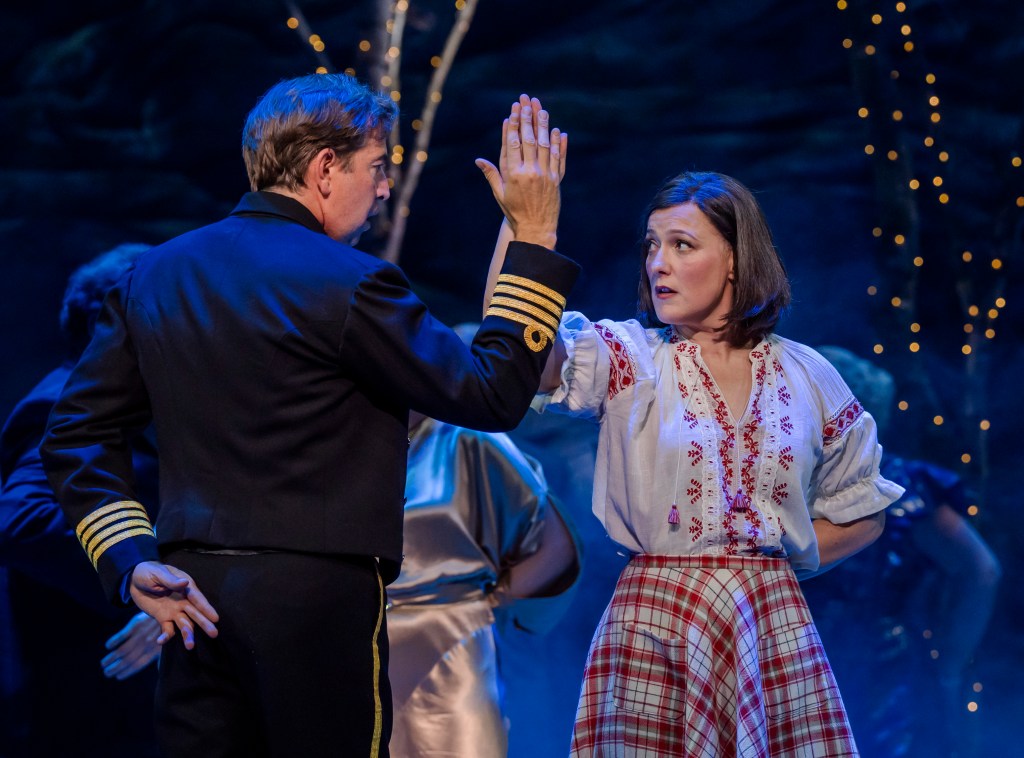
The Mother Abbess gets the story out of Maria and advises her to return, telling her that being in love and raising a family, is as much a part of devotion as praying in an abbey. Maria takes her advice and returns. The Baroness, sensing the mutual affection between the Captain and Maria, calls off the engagement and returns to Vienna. As you would have guessed, the couple get married and go on honeymoon.
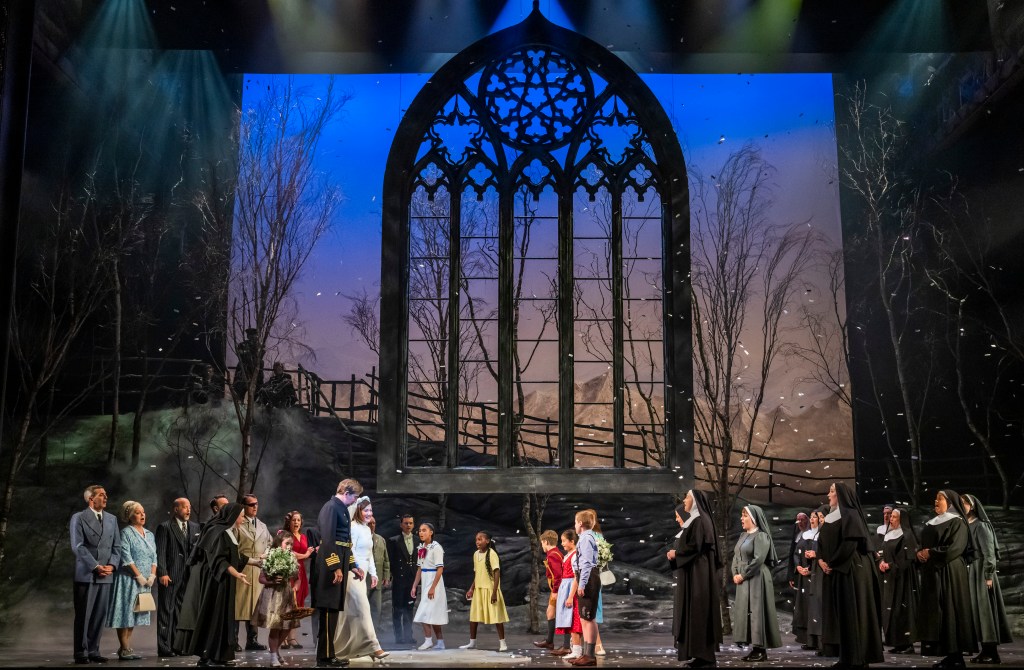
During their absence, Austria has been annexed by Nazi Germany and the population put under strict martial law. The Captain is a committed Austrian patriot and cannot be a part of the new regime, even refusing to return the Heil salute. Being a national hero, he is ordered by Admiral von Schreiber, to report immediately to the port of Bremerhaven, where he will take command of a German warship. Not being able to bring himself to do this, he hatches a plan to escape with his family to Switzerland, which is neutral, using the Salzburg Festival as a cover. The family sneak out of the auditorium whilst the awards of the Festival are being presented and head for the Abbey, where the nuns help them flee to the border. The von Trapps are caught by a Nazi soldier who turns out to be Rolf Gruber, a young boy who the Captain’s daughter, Leisl, has been secretly meeting. He lets them pass and they make their escape.
I thought that every part of this production was superb, except for one thing – integrity. I won’t go any further here but will explain at the end of the piece in an epilogue, as there will be spoilers and I have no wish to mar your experience should you want to go along and take everything at face value.
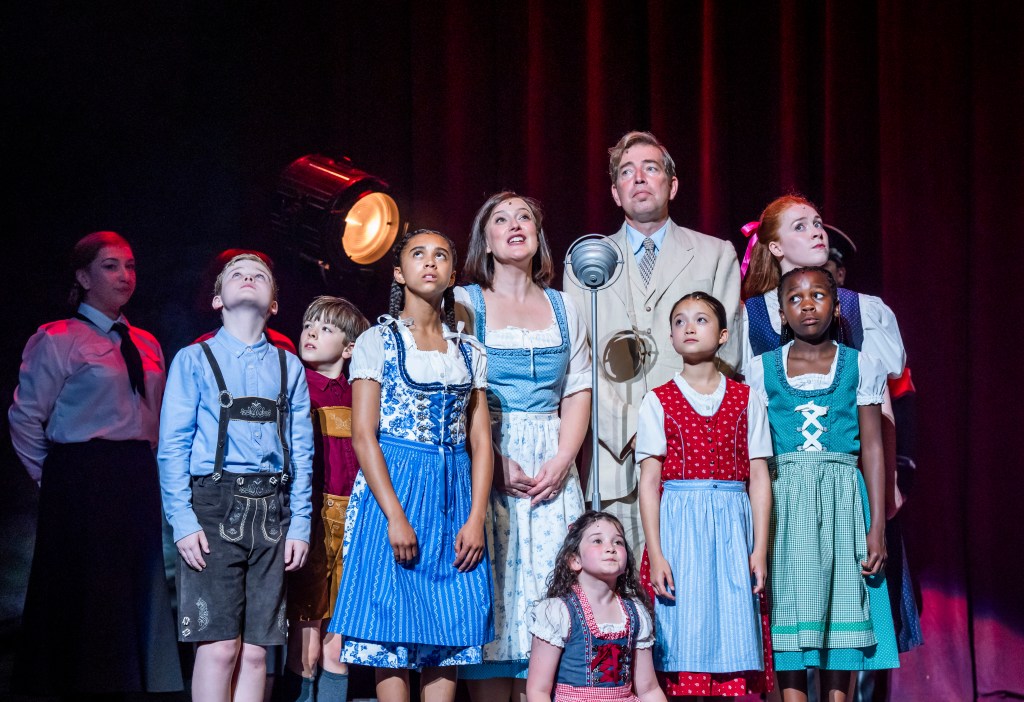
We know the songs, although there are two included which were not in the film, and they were all sung incredibly well by those concerned. The pick of the bunch was Climb Ev’ry Mountain, performed by Katherine Broderick as The Mother Abbess. Her voice, as you would expect from a world renown opera singer, was perfectly suited to this piece, which is meant to be sung, rather than acted, unlike most of the others. Not for nothing is it positioned as the last song in the first half; the curtain closing was about the only thing which could stop the applause from lasting for hours.
Katie Bird as Maria, had the balance between acting and singing down to a fine art, mellowing from precocious young lady to responsible, but still light-hearted adult before our eyes. The chemistry between her and the children was palpable.
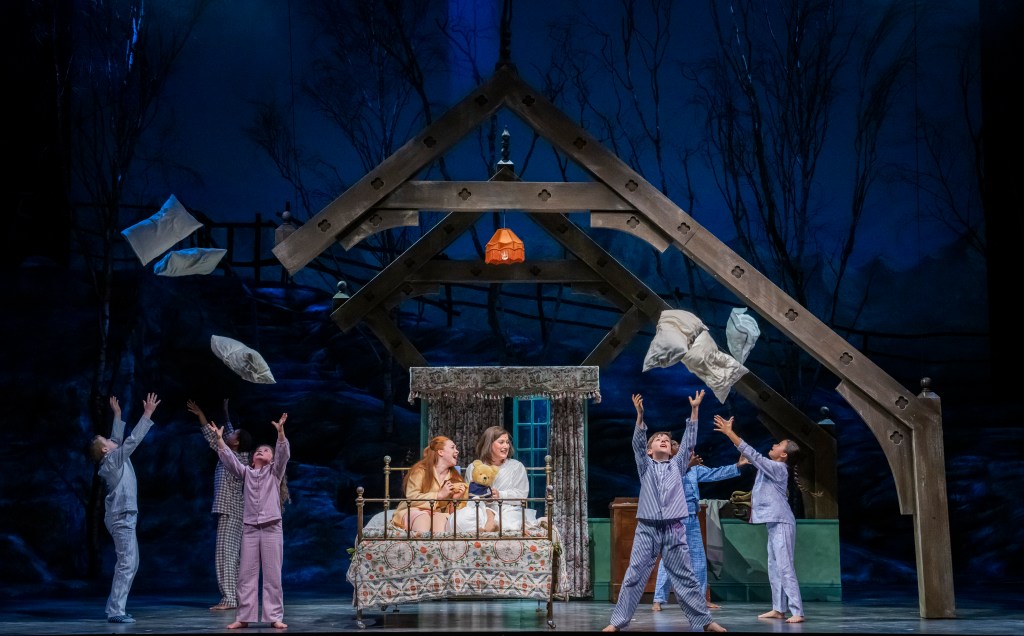
Speaking of the children, they were a revelation. I have seen more than my fair share of shows featuring youngsters, most of whom recited their lines rather than acted them, this group, however, added the nuance of actors at least treble their age. The small facial gestures and body language was a delight. I am purposely not mentioning any names here for two reasons; first, because of the age range involved – there were seven of them – it would be unfair to single any out when they were at different stages (pun intended) of their development, and second, there are two sets (pun not intended) of young performers who alternate shows, so the ones you see might be different from those in the show I saw. We got Team Drop, the other being Team Rain, odd choices but preferable to Team Schnitzel and Team Noodles I suppose. I was seated next to a couple whose daughter was in the cast and they were, deservedly, bursting with pride.
Edward Bennett played Captain Georg von Trapp, cutting a dash as an elegant fellow with the required military bearing whilst still exuding an air of compassion and humanity, mainly after Maria had demobilised the children from their platoon and given the house a more relaxed atmosphere. His rendition of Edelweiss at the Salzburg Festival was sung with the pride and emotion demanded by the plot.
Amy Freston, as Baroness Elsa Schraeder, is a member of the Chorus of Opera North and so very much at home in the Grand Theatre. She was spot on as the aristocrat, splendidly elegant in long white gown and tightly permed blonde wig, her voice, as you would expect, effortlessly shifting from the spoken word to song. She featured in the two pieces not included in the film, both of which introduced the darker element of the show, concerning the Anschluss. Her character decides to submit to the new regime for the sake of expediency, thus being another element in the cancelling of her engagement to The Captain.
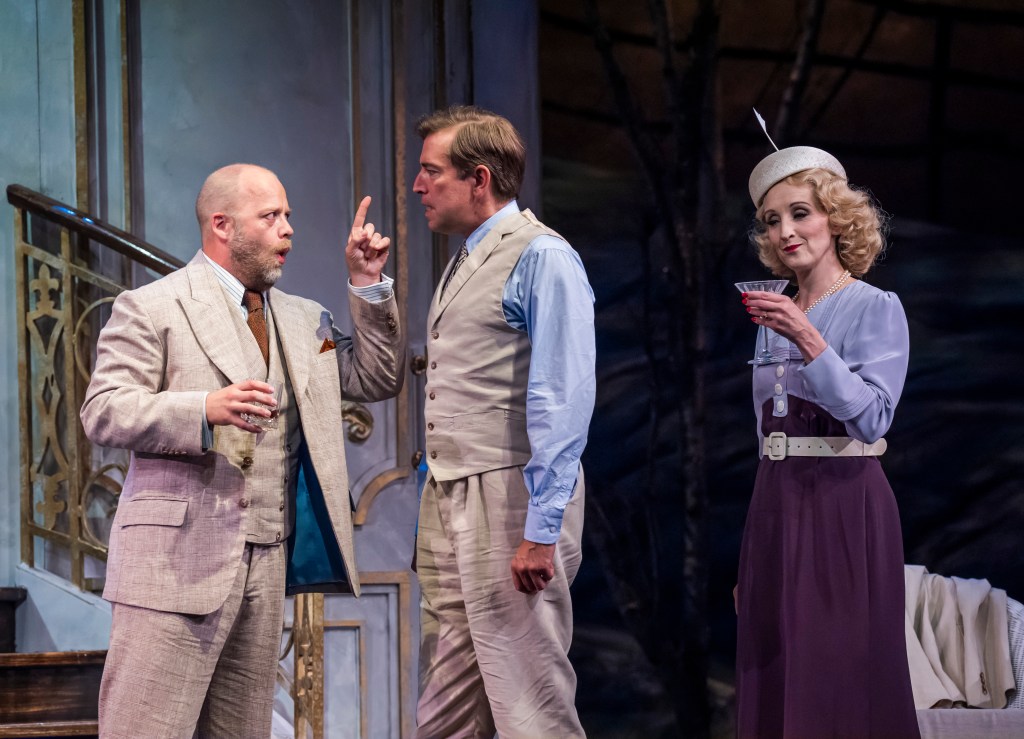
Nicholas Butterfield, another member of the Chorus of Opera North, played Max Detweiler, who also decides on what appears to be the easy option by joining the Nazis. His demeanour reflected that he was a natural capitulator. He also made up the trio of voices in the two darker show songs, along with The Captain and The Baroness; How Can Love Survive? and No Way To Stop It.
Ivan Sharpe as Herr Zeller and Tim Ochala-Greenough, Admiral von Schreber, added a very convincing threat as the two main Nazi military officers, determined that Captain von Trapp would take up his post in Bremerhaven, by whatever means were necessary.
The Orchestra of Opera North, conducted by Oliver Rundell, were – as usual – on top form, the sound of a forty-piece ensemble really is something to behold.
All of the other creatives excelled themselves. Ebony Molina, Choreographer, not only worked her magic with the children, but had everyone else’s movements nailed. During the party scene the various guests imperceptibly began to separate into two camps, pro and anti Nazi, until there was an open hostility between them, which didn’t explode into action, but beautifully illustrated the depth of feeling involved.
Mark Henderson was the Lighting Designer, whose skill with the illumination was only matched by the incredible use of the lack of it. When the von Trapps had made their escape, the theatre plunged into darkness with actors in SS uniforms situated in the boxes next to the stage, holding powerful torches, which they pointed at various parts of the auditorium as if searching for their prey, along with some others who were hunting on the set, it was quite an unnerving effect. Sebastian Frost’s Sound Design, not only added to this unease, but but was a huge asset throughout the show.
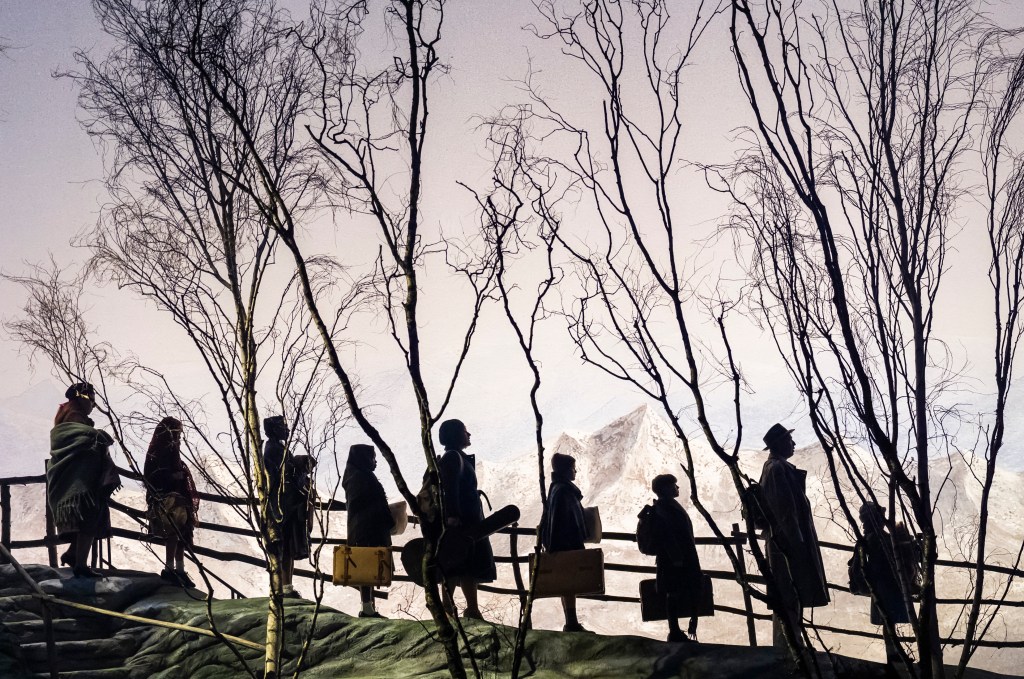
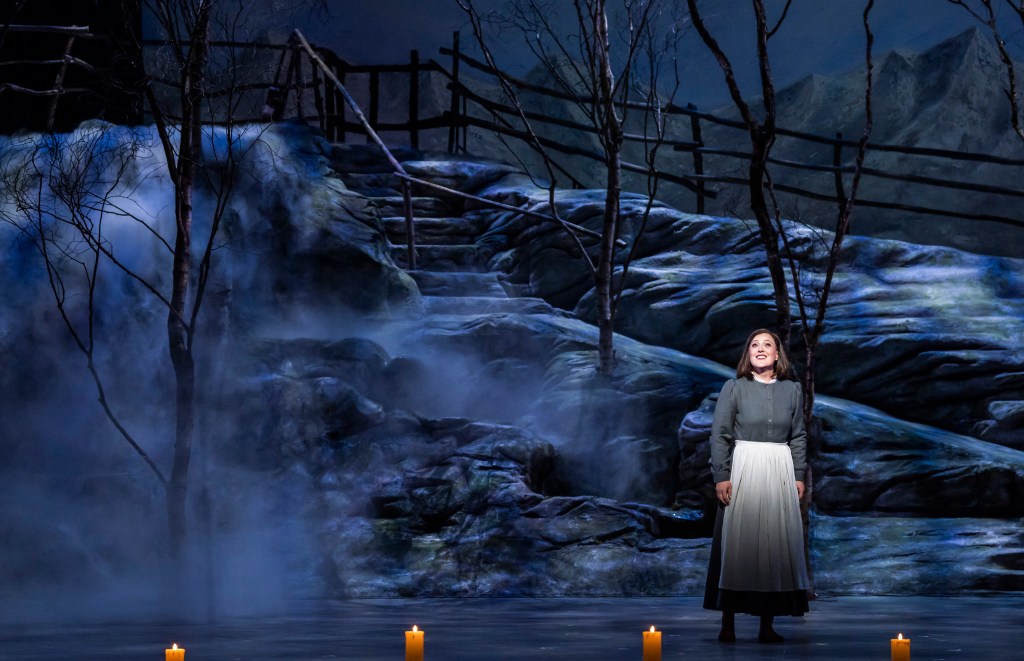
What I found to be most impressive was the set, which, along with the costumes was designed by Michael Taylor. As you would imagine, the backdrop was the Alps which had a zig-zag footpath leading from stage level to half way up the height of the mountains. This came into its own at the beginning, when Maria sings the title song and at the very end, when the family are shown in silhouette, carrying their belongings and scaling the peak to facilitate their escape to Switzerland. For every scene, props were lowered from the flies and, whilst obliterating part of the view outside, there was always some part of the hills showing as a constant reminder of place. The only exception was at the Salzburg Festival when the whole backdrop comprised a red curtain with a swastika to indicate that the area was to be dominated by the Germans. Brilliant.
The Director was Nikolai Foster, who brought everything together superbly.
There is one more creative, Ollie Kurshid, who is Revival Director, and I have no idea what that is, but was probably executed brilliantly as well.
The Sound of Music runs at Leeds Grand Theatre until 1st August and I do heartily recommend you go and see it. For more details and to book, please go to https://leedsheritagetheatres.com/whats-on/on-sound-of-music-2026
To see the forthcoming presentations from Opera North see https://www.operanorth.co.uk/whats-on
To see what else is coming to Leeds Heritage Theatres please go to https://leedsheritagetheatres.com/whats-on/?genre=live
Photography by Tristram Kenton
EPILOGUE
I feel churlish for writing this, but whilst I enjoyed the show, I was disappointed by the casting. I am all in favour of diversity – in fact in a review I wrote last Christmas I complained about the lack of it – but only when it doesn’t affect the main thrust of the piece. The children here were magnificent, however, the multi racial aspect undermined the whole foundation. The von Trapps were real people and were white Austrians. I realise that this is an unintended consequence, but the make up of the cast could only have had one interpretation, which is to suggest that their mother was a serial adulteress. I accept that refugees in today’s world come from all parts of the globe to escape persecution but if you need to include actors of colour to draw that parallel then you disrespect your audience for not having the intelligence to make the connection without it being spelt out to them.
The other fundamental consequence was that the dilemma faced by Captain von Trapp was the decision he had to make as to whether to do as his fiancée and his friend were doing, and support the Nazis, thus hoping his family would be safe, or escape to a neutral country. The aims of the Nazis were to dominate the world and rid it of anyone not of the Aryan race, a term Hitler misused to mean white, blond, blue-eyed people, so the decision to stay would never have been an option had he had children of colour, as, the minute he left for Bremerhaven, they would have been killed by the regime, or sent to concentration camps, for not conforming to the blueprint.
Whilst doing my research before writing this piece, I came across an article that said Captain von Trapp was not the stickler for military discipline regarding the bringing up of his children, but continued in the same vein as his late wife and allowed music, laughter and casual dress, it was the writers of the original show who decided it would make a better story if they portrayed him as a Tartar. Naturally, this deeply upset his surviving family, and now, here we are, almost seventy years later, demeaning both him and also his late wife.
I realise that the story has been embellished in many other way so as to make it almost fiction, Maria was sent to the Captain as a nurse in 1927, not as a governess in 1938; they didn’t climb every mountain to escape the Nazis, but simply walked out of the front door with their luggage and caught a train to Italy before getting another to Switzerland, after which they came to London and then settled in the USA where they performed in theatres and sold shed loads of records. The fact still exists though, that these were real people and deserve to be treated with respect. I just hope that the one surviving von Trapp ‘child’, Johannes, who is now 86, the son of Georg and Maria, and lives in Vermont, doesn’t decide to visit Leeds and get a ticket for the show, to see what they have done to his step-siblings.
 Tyke It To The Limit